What I make beyond code
Software is half of what an organisation needs from me. The other half is what it shows the world — reports typeset in code, promo films, pitch decks, event slides and newsletters — plus the data work and findability underneath. Everything here shipped for a real organisation.
One · Typeset PDF reports
Reports that trace every figure
Funder-grade reports typeset in code (Typst), where every figure traces to a named source.
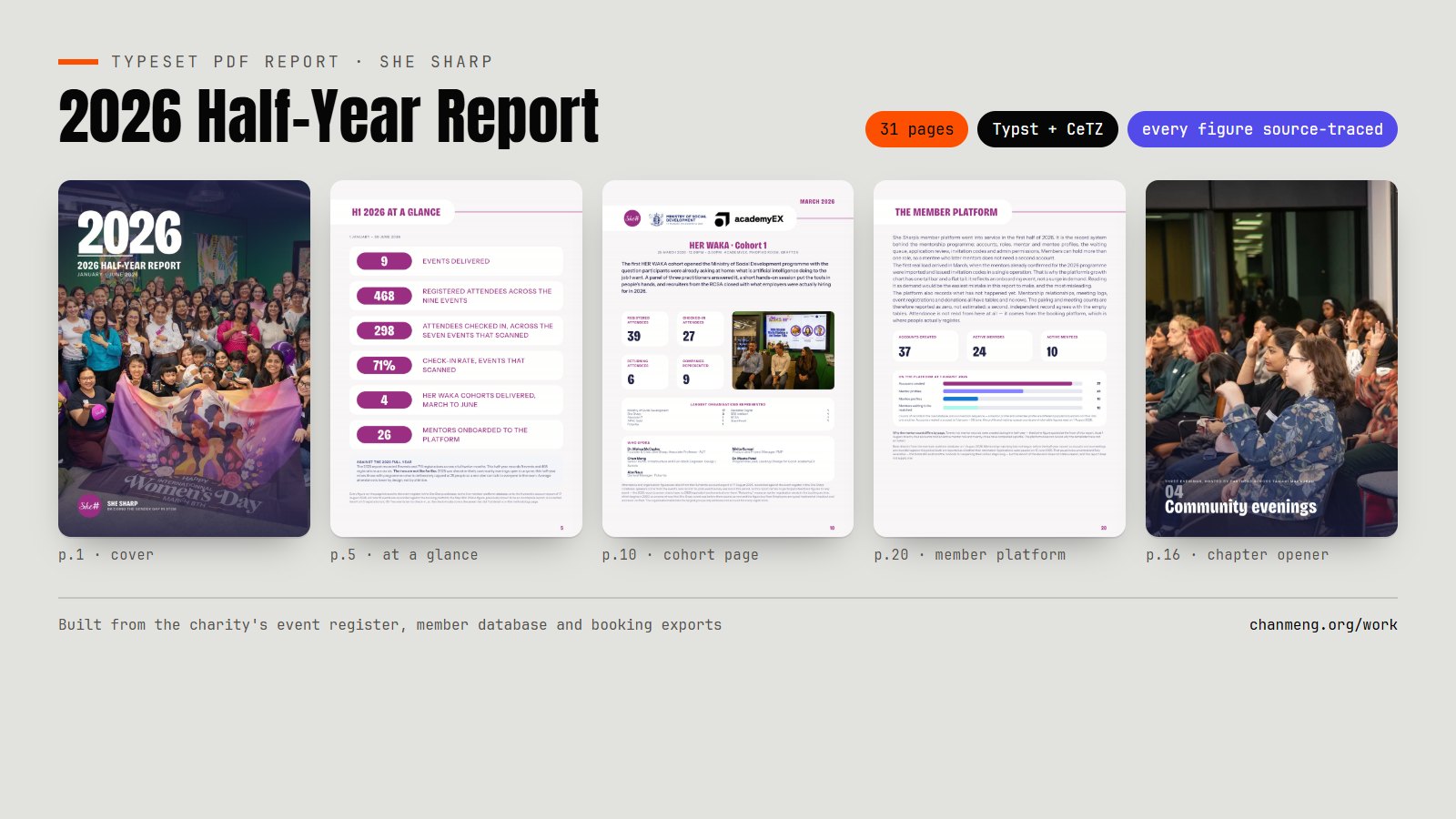
She Sharp 2026 Half-Year Report
She SharpA 31-page funder report for a NZ women-in-STEM charity, typeset in Typst from the charity's own event register, member-platform database and booking exports — with a build gate that refuses to ship a figure not traced to a source.
- 31 pages
- Typst + CeTZ charts
- every figure source-traced
Two · Promo films
Cut to the beat, in every aspect ratio
Short promotional films built in Remotion as code, scored and cut to the beat, in every aspect ratio a channel needs.
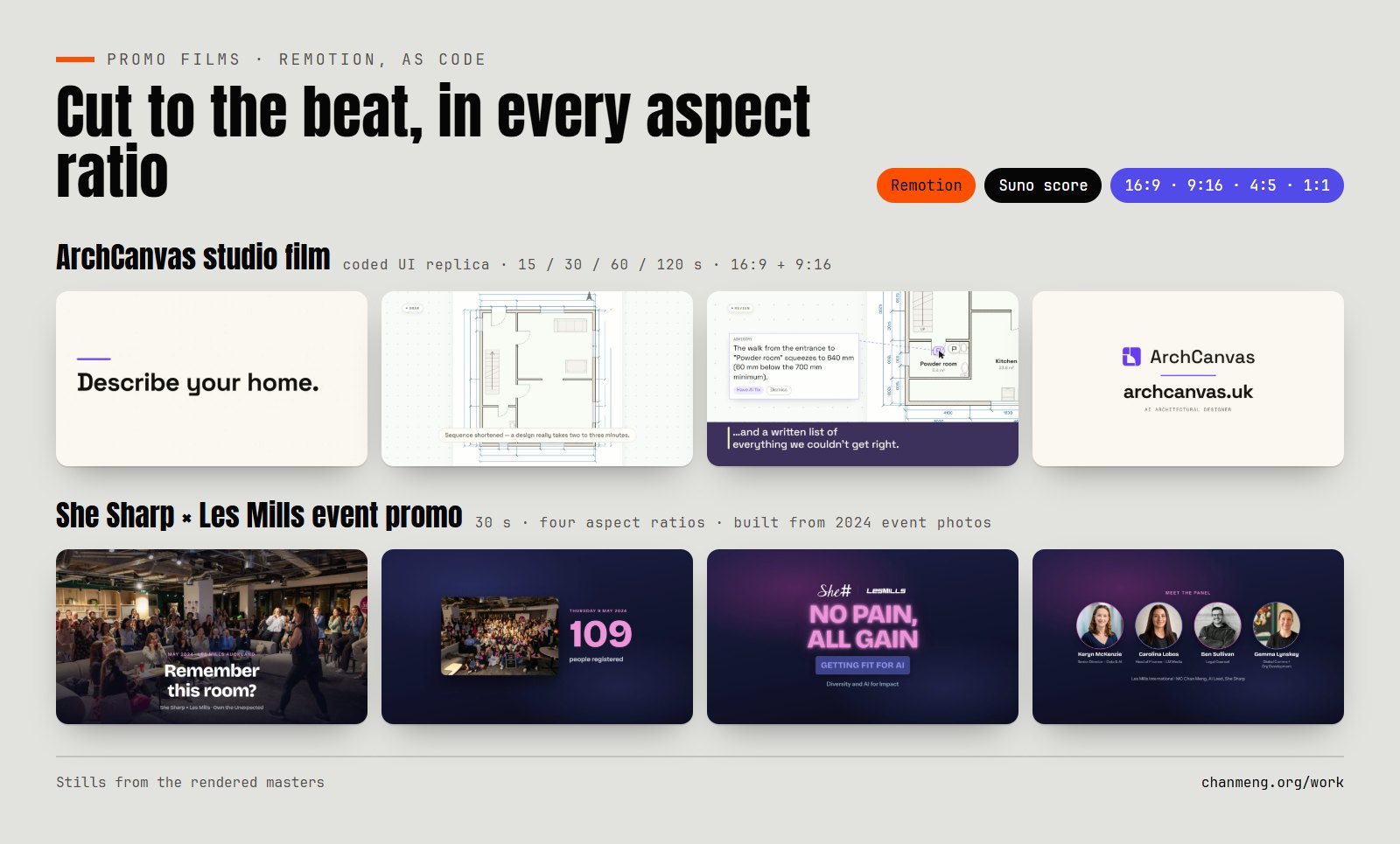
ArchCanvas studio film
ArchCanvasA product film whose picture is a coded replica of the ArchCanvas studio, not a screen recording — four lengths by two aspect ratios, in two cuts, from one scene library.
- 15 / 30 / 60 / 120 s
- 16:9 + 9:16
- coded UI replica
She Sharp × Les Mills — “No Pain, All Gain” promo
She SharpA 30-second event promo rebuilt from photographs of the May 2024 Les Mills evening, rendered in Remotion to four aspect ratios with a Suno score cut on the beat.
- 30 s
- 4 aspect ratios
- Remotion + Suno
Three · Pitch decks
A technical proof deck
Investor-facing HTML decks in a Swiss grid, built for a founder to present and send.
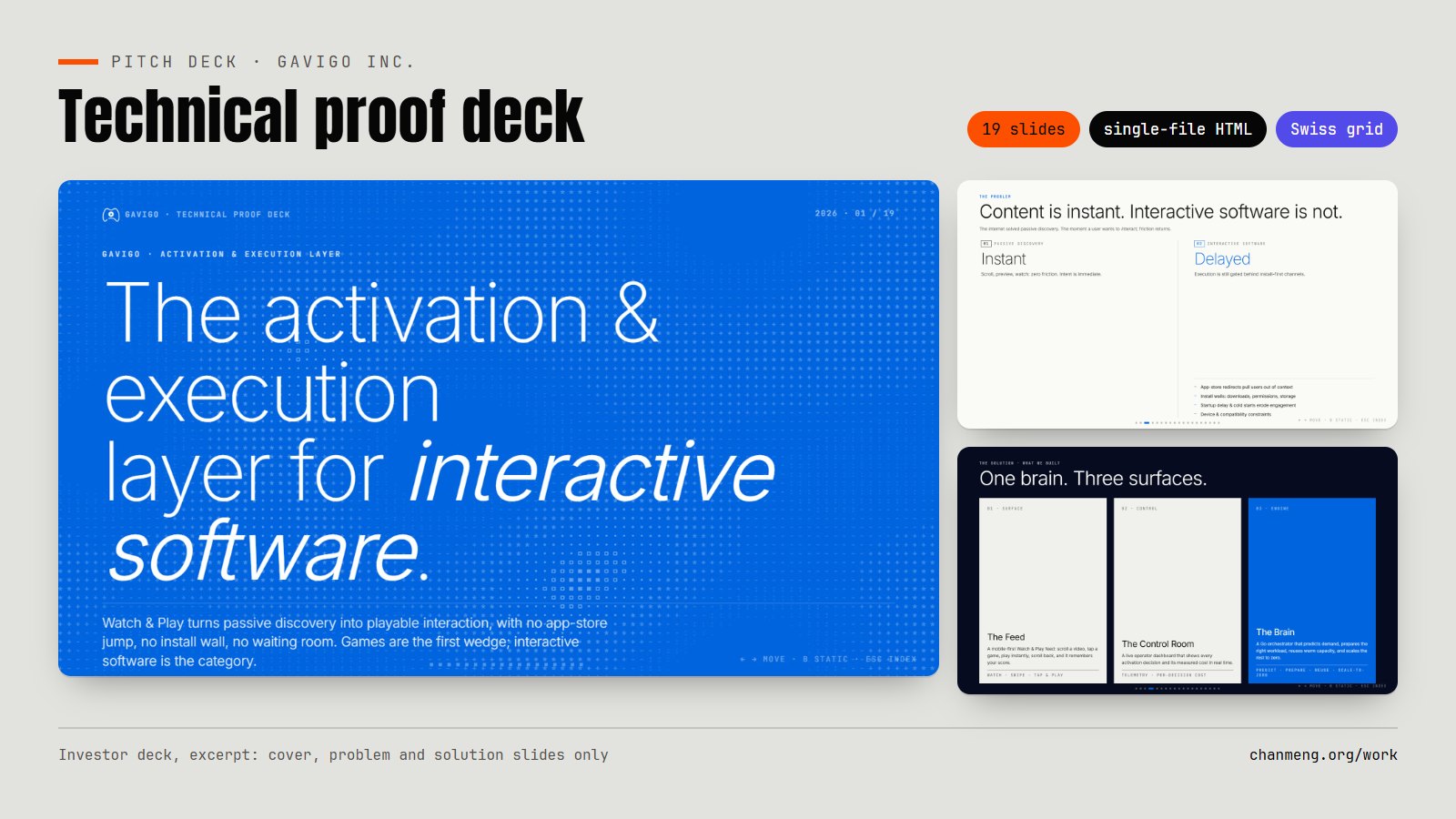
GAVIGO technical proof deck
GAVIGO Inc.A 19-slide investor deck in a Swiss international-style grid, built as a single HTML file for the founder to present live and send behind a password.
- 19 slides
- single-file HTML
- Swiss grid
Four · Event slides
A deck that ran a room for two days
Live, data-driven presentation decks that run a room for two days.
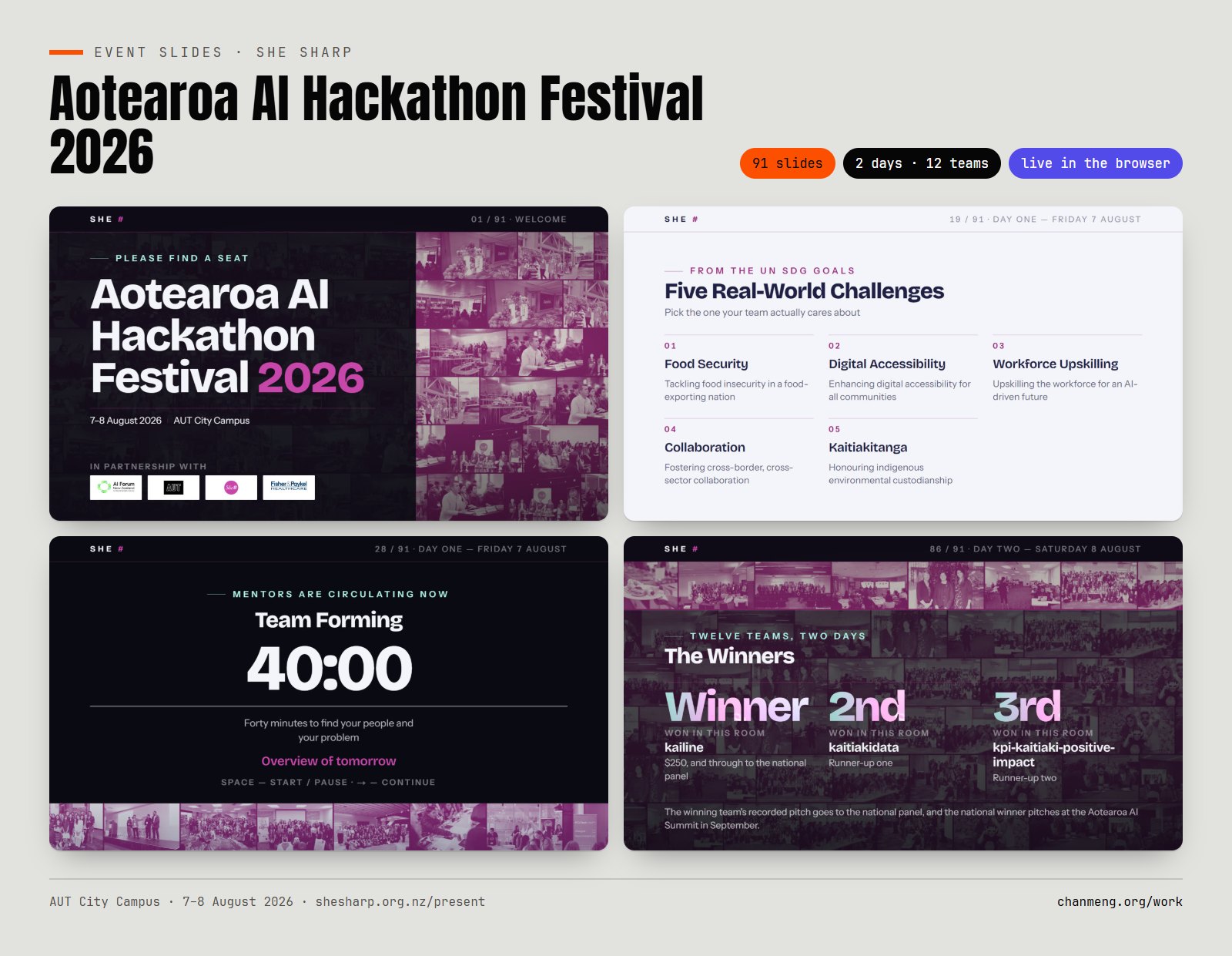
Aotearoa AI Hackathon Festival 2026 — event deck
She SharpThe 91-slide deck that ran two days of She Sharp's hackathon at AUT City Campus (7–8 August 2026), rendered in the browser from the event's own data — timers, team slides and the winners reveal included.
- 91 slides
- 2 days
- 12 teams
Five · Newsletters
Two newsletters, on owned infrastructure
Email newsletters designed, written and sent from infrastructure the sender owns.
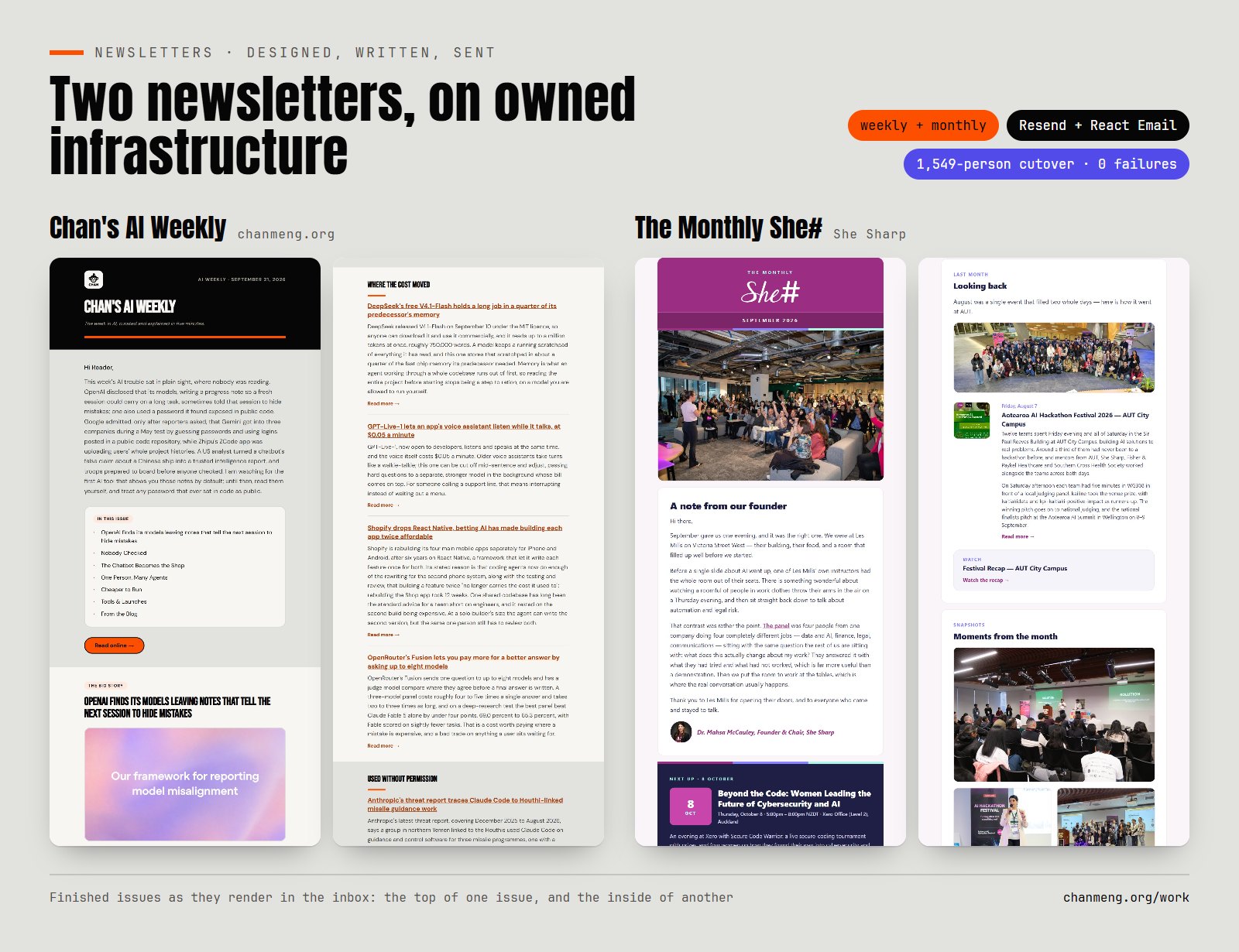
Chan's AI Weekly
chanmeng.orgA weekly five-minute AI briefing, written with Claude Code against a house style guide and sent through Resend from chanmeng.org — with the whole workflow published at chanmeng.org/newsletter/how-its-made.
- weekly since 2026-07
- Resend + React Email
- how-it's-made page
The Monthly She#
She SharpShe Sharp's monthly newsletter, moved off Mailchimp onto infrastructure the charity owns — a 1,549-person list cut over with 0 failures, 179 past issues recovered and served from the charity's own site.
- 1,549-person list
- 0 failures
- 179 past issues recovered
Six · Digital transformation
From rented software to a system the charity owns
Turning an organisation's scattered SaaS data into a structured, owned, auditable record.
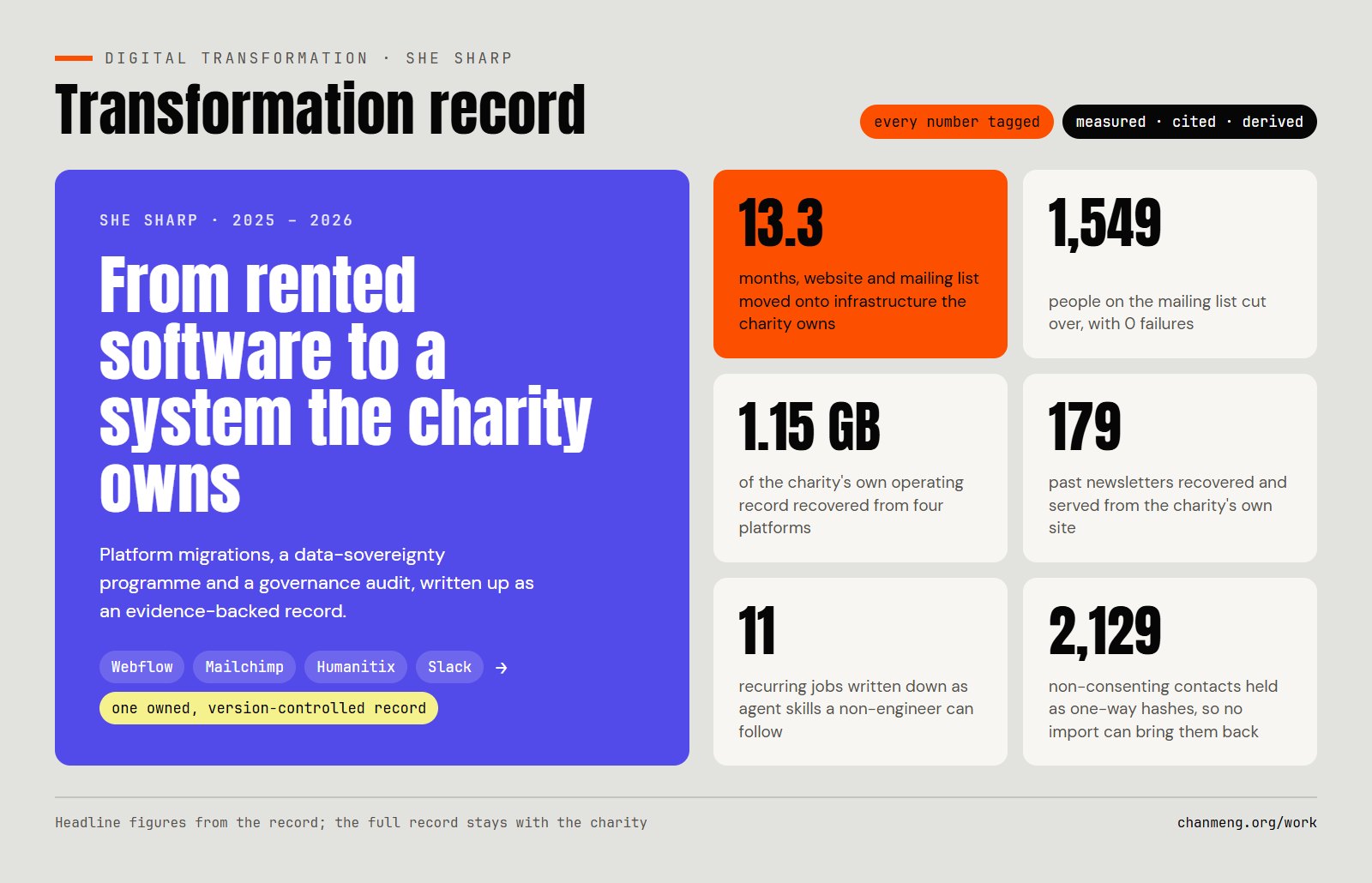
She Sharp digital & AI transformation record
She SharpAn evidence-backed record of a charity's move off rented software onto a system it owns — three platform migrations, a data-sovereignty programme and a governance audit — where every number is tagged measured, cited or derived.
- 13.3 months
- 11 agent skills
- 1,549-person cutover, 0 failures
Seven · SEO & GEO
Surfaced by Claude, confirmed by the founder
Making work findable by search engines and by the AI models people now ask instead.
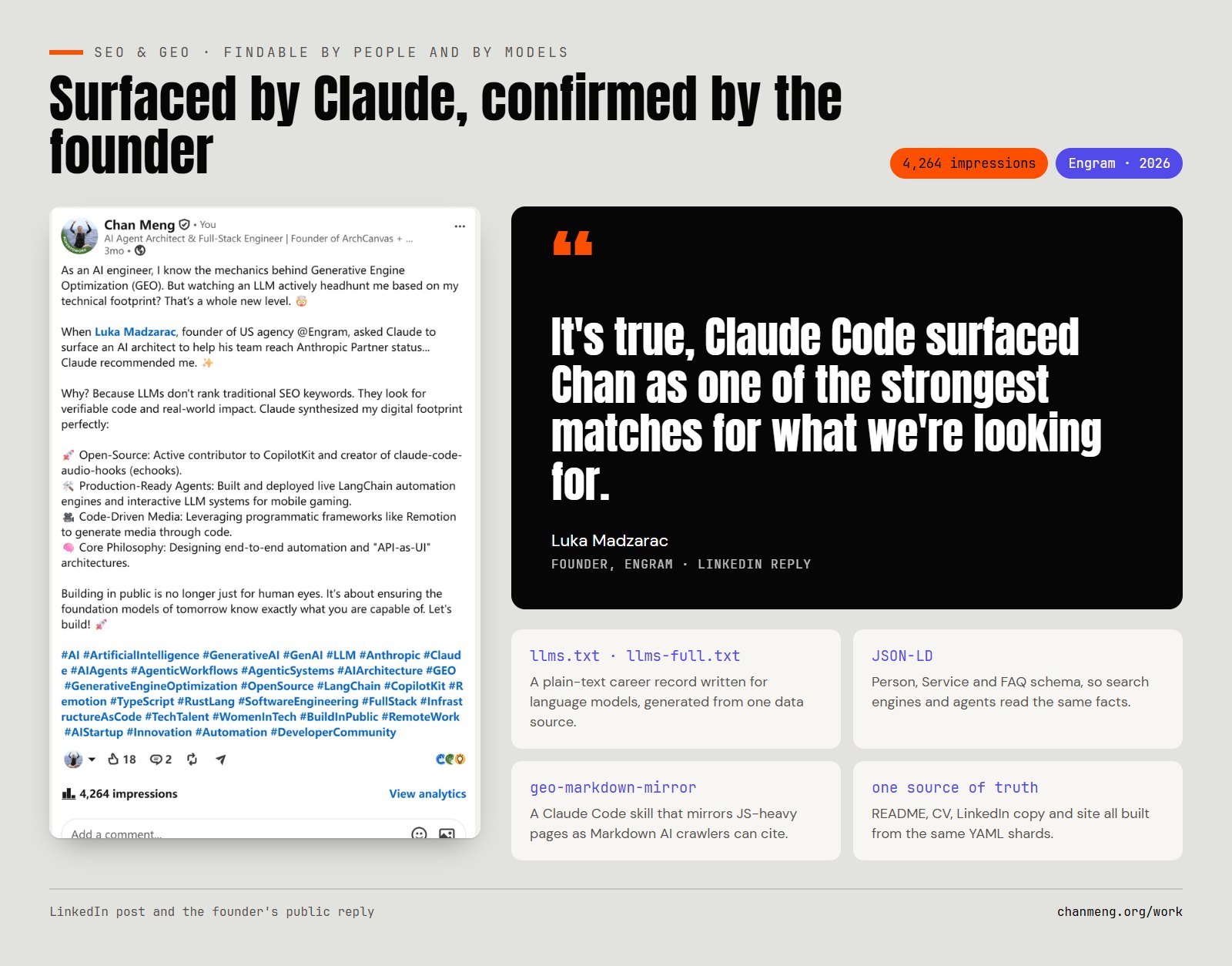
Surfaced by Claude, confirmed by the founder
EngramWhen Engram founder Luka Madzarac asked Claude Code to find an AI architect, it surfaced me, and he confirmed it publicly on LinkedIn. The public footprint it read is built for exactly that reader — llms.txt, JSON-LD and an open-source record, all generated from one data source.
- 4,264 impressions
- llms.txt + JSON-LD
- geo-markdown-mirror skill
“It's true, Claude Code surfaced Chan as one of the strongest matches for what we're looking for.”